
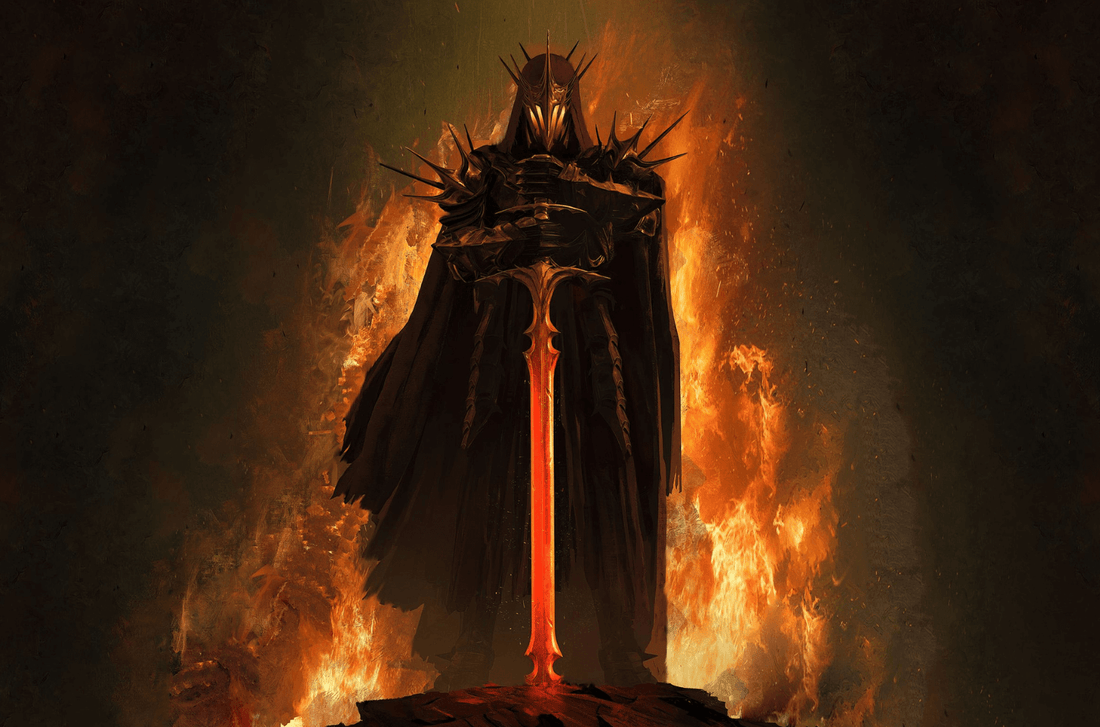
The Origin of the Witch-king of Angmar
Share
The Witch-king of Angmar is one of the most sinister and iconic figures in JRR Tolkien's Legendarium , appearing in particular in "The Lord of the Rings" and "The Silmarillion" . He is the leader of the Nazgûl ( Ringwraiths ), and one of Sauron's most faithful servants. Here is an overview of the origin and journey of this mythical character.
Origins of the Witch-King
The Witch-king, before becoming a spectral entity, was originally a great human king. However, Tolkien does not provide us with specific details about his human identity before his corruption. What is clear is that he was one of the Nine Kings of Men who received Rings of Power from Sauron during the Second Age .
These rings, created by Sauron to control the free peoples, were intended to seduce their wearers with the promise of immense power and increased longevity. However, this promise was a trap: the kings who wore them fell under Sauron's influence and became Nazgûl, wraiths deprived of their free will and slaves to the One Ring. Of these nine lords, the one who would become the Witch-king of Angmar was the most powerful and feared. He eventually became the leader of the Nazgûl, known as the Chief of the Nine .
The Creation of the Kingdom of Angmar
After his transformation, in the Third Age , the Witch-king was sent by Sauron to weaken the Dúnedain kingdoms in the north, heirs to Numenor . Around the year 1300 of the Third Age , he established an evil kingdom north of the Misty Mountains, which he called Angmar . Its capital was the dark fortress of Carn Dûm , nestled in the Grey Mountains.
The goal of this kingdom was clear: to destroy the last strongholds of the Dúnedain royal line in Arnor. At this time, the kingdom of Arnor was already divided into three sub-kingdoms: Arthedain , Cardolan , and Rhudaur , which made its territories more vulnerable to external invasion. The Witch-king took advantage of this division and used his power to foment internal conflicts, corrupt certain lords, and launch destructive military campaigns against these kingdoms.
The Fall of Arnor and the Defeat of the Witch-King
Under the repeated assaults of the Witch-king, the kingdoms of Arnor gradually collapsed. Rhudaur was the first to fall, followed by Cardolan, and finally Arthedain, whose capital, Fornost , was taken in 1974 of the Third Age . This event marked the end of the kingdom of Arnor. However, the victory of the Witch-king was short-lived.
The following year, in 1975 , a coalition of Elves from Lindon, under the leadership of Círdan , and the Dúnedain of the south (Gondor), led by Prince Eärnur , launched a counteroffensive. The Witch-king's forces were crushed at the Battle of Fornost , and he was forced to flee Angmar. As he fled, the Witch-king confronted Eärnur, but thanks to his wraithlike power, he escaped capture. This defeat marked the end of the kingdom of Angmar, but the Witch-king remained a threat.
Return to the Service of Sauron
After the fall of Angmar, the Witch-king returned to the shadows and continued to serve Sauron. He played a central role in the Dark Lord's rebirth at Dol Guldur during the Third Age , and later in the events leading up to the War of the Ring. As leader of the Nazgûl, he was sent in search of the One Ring, which had resurfaced in Middle-earth.
During the War of the Ring , the Witch-king led Sauron's armies against the free peoples, most notably at Minas Tirith at the Battle of the Pelennor Fields . It was during this battle that he met his end, after being challenged by Éowyn , the niece of King Théoden of Rohan, and the hobbit Meriadoc Brandybuck . Éowyn, protected by a prophecy that stated that no man could kill him, managed to defeat him with the help of Merry.
Conclusion
The Witch-king of Angmar embodies one of the greatest tragedies in Tolkien's Legendarium : that of the corruption and fall of a powerful king, transformed into a specter in the service of absolute evil. His legend is marked by destruction, hatred and ambition, but also by his central role in the plans of Sauron, whom he served until his own destruction.