
The History of Númenor
Share
Númenor, a mythical island in J. R. R. Tolkien's universe, lies at the heart of Middle-earth's history, marking a pivotal point in the narrative of The Silmarillion and Unfinished Tales . Often described as the greatest human civilization of the Second Age , Númenor embodies the greatness, but also the tragic fall, of a people once blessed by the Valar.
The Founding of Númenor
Númenor was created as a gift from the Valar to Men who fought alongside the Elves against Morgoth, the first Dark Lord, at the end of the First Age . These Men, known as the Dúnedain, were given this island between Middle-earth and Valinor (the realm of the Valar). Númenor is often compared to the mythological Atlantis, both for its splendor and its fall.
The early inhabitants of Númenor, led by Elros (the brother of Elrond, the famous Elven Lord), enjoyed a long prosperity. Elros, son of Eärendil and the Elf Elwing, had chosen to live as a mortal man, and was crowned as Tar-Minyatur, the first king of Númenor. The Númenóreans were blessed with exceptional longevity, profound knowledge, and technological and maritime gifts that placed them far above other Men.
The Golden Age of Númenor
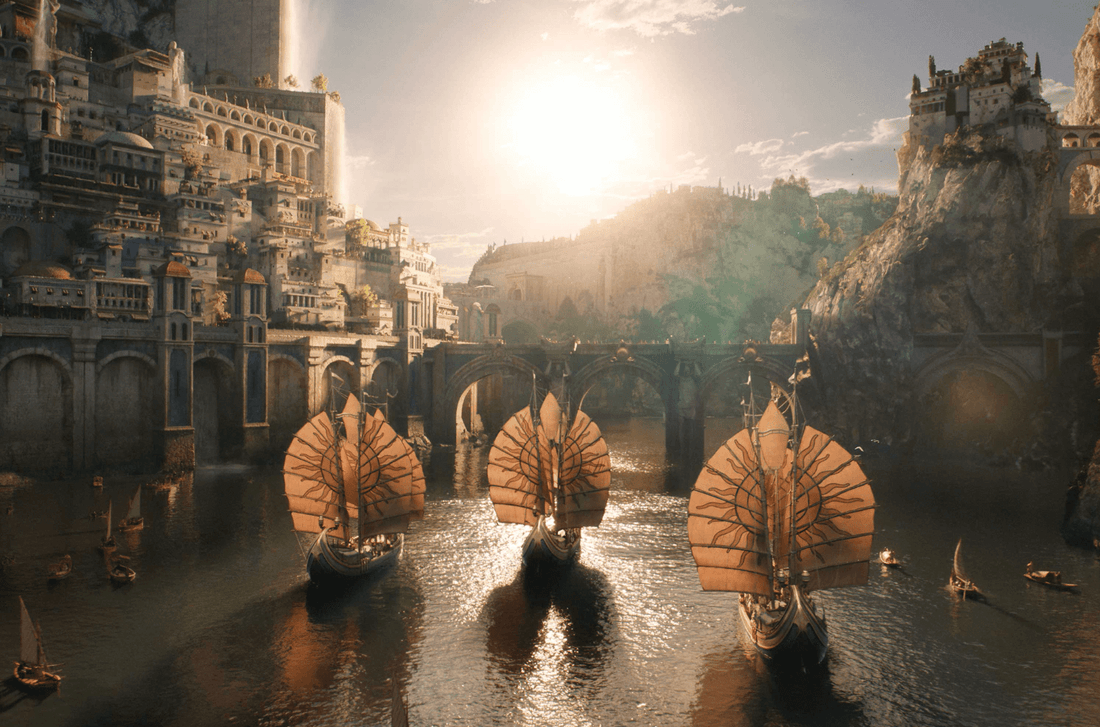
Under the rule of the First Kings, Númenor prospered as never before. The Númenóreans became great explorers, sailing in mighty ships, building peaceful relations with the Elves, and bringing aid and knowledge to the Men of Middle-earth. However, despite their power, the Númenóreans were forbidden by the Valar to approach Valinor, the immortal land of the gods, in order to respect the condition of their mortality.
This golden age was characterized by a period of peace and discovery where the Númenóreans lived in harmony, strengthening their ties with the Elves. The kingdom became a center of learning and culture, and its capital, Armenelos, rose as the most majestic city of the time.
The Rise of Pride and the Beginning of the Fall
As the centuries passed, the shadow of mortality began to weigh heavily upon the Númenóreans. They became increasingly obsessed with their own finiteness and jealous of the immortality of the Elves and Valar. This resentment caused them to turn away from their former allies. This transition began most notably under the reign of King Tar-Atanamir, who refused to accept the gift of mortality as a blessing.
This rift was exacerbated by the arrival of Sauron, who, after being captured in the wars in Middle-earth, manipulated the Númenóreans by settling in Númenor as an advisor to King Ar-Pharazôn. Sauron, eager to corrupt this great civilization, encouraged the building of temples to Morgoth, and introduced unholy practices that marked the moral decline of the kingdom. Under his influence, Ar-Pharazôn and his people began to renounce the Valar and seek ways to obtain immortality.
The Fall of Númenor
The fall of Númenor was inevitable under the reign of Ar-Pharazôn. Driven by pride and a desire to rival the gods, Ar-Pharazôn decided to send a massive fleet to invade Valinor and claim immortality for Men. This final act of defiance angered the Valar, who called upon Eru Ilúvatar, the Maker, to intervene directly.
In response to this audacity, Ilúvatar turned the world upside down. Númenor was swallowed up by the waves, disappearing forever into the depths of the sea. The immortal land of Valinor was removed from the physical world, inaccessible to mortals. This cataclysm also marked the transformation of Middle-earth, with the creation of the spherical shape of the world (previously flat in Tolkien's mythology).
Only a few Númenóreans, who remained loyal to the Valar, managed to escape the destruction. Led by Elendil and his sons, Isildur and Anárion, these survivors fled to Middle-earth and founded the kingdoms of Gondor and Arnor, continuing the legacy of Númenor in a new context.
The Legacy of Númenor
The history of Númenor is a classic tragedy of downfall through hubris and corruption, but it also sowed the seeds for the events of the Third Age . The exiled Dúnedain carried on the culture and nobility of Númenor in the northern and southern realms of Middle-earth. Isildur, descended from this line, would play a crucial role in the downfall of Sauron at the end of the Second Age , by cutting the One Ring from the hand of the Enemy.
The fate of Númenor remains a powerful parable in Tolkien's legendarium, symbolizing the tension between the mortality of Men and their desire to transcend their condition, often at their own peril. The influence of this story is also seen in the importance of the realms of Men, which will play a central role in the events of The Lord of the Rings .
Thus, Númenor remains a poignant reminder that even the greatest civilisations can collapse under the weight of their own ambition, a lesson in humility in a world of constant transformation.